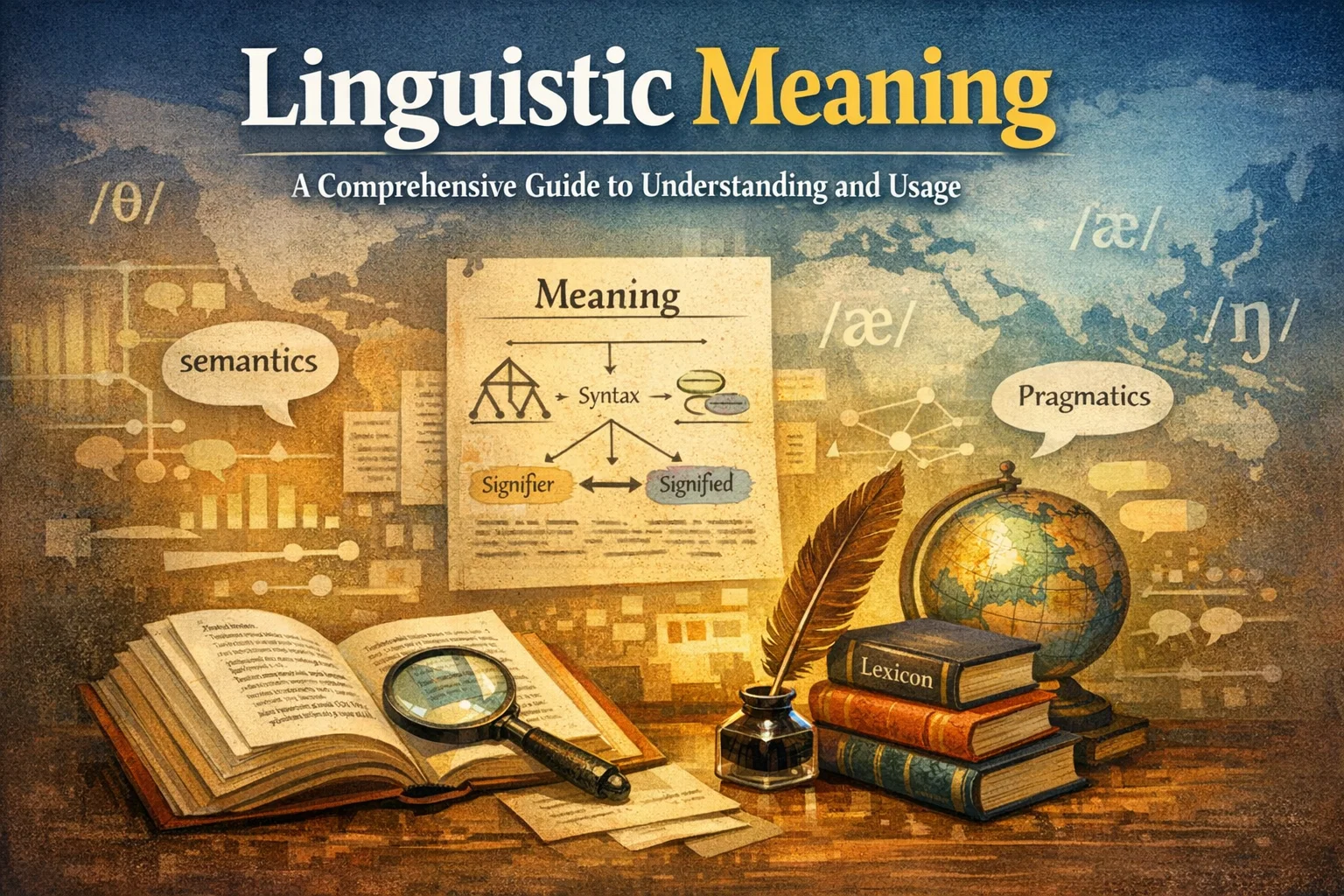
Linguistic meaning is one of the core aspects of linguistics, defining how words, phrases, and expressions convey sense in different contexts. Understanding linguistic meaning is not only an academic interest but also a practical tool for clearer communication, grasping cultural nuances, and effectively transmitting ideas. In everyday life, we constantly use linguistic units, yet we rarely consider the multi-layered meanings they carry.
When discussing linguistic meaning, it is important to consider not just the direct, literal sense of words but also their pragmatic, cultural, and social context. For instance, the same word can convey different emotions and impressions depending on the situation, tone, and audience. This makes the study of linguistic meaning rich and fascinating, as it sits at the intersection of grammar, semantics, and social communication.
Semantic Foundations of Linguistic Meaning
Semantics is the study of the meaning of linguistic units and their combinations. It focuses on how words and expressions convey sense and how that sense can be interpreted. At the heart of linguistic meaning is the relationship between a sign and what it denotes. For example, the word “home” carries not only its objective definition as “a place to live” but also a range of subjective associations like comfort, safety, and family.
One interesting feature of semantics is polysemy—the ability of a single word to have several related meanings. Polysemy is common in natural language and presents challenges for both language learners and translators. It reveals how flexible and dynamic linguistic meaning is, demonstrating that sense is not fixed but contextually determined.
Pragmatic Aspects of Linguistic Meaning
Pragmatics focuses on how context influences meaning. Words do not exist in isolation; they gain significance through usage. Linguistic meaning includes not only what is said but also how it is said and how it is understood by the listener. For instance, the sentence “You might come” can indicate a simple prediction or, with a certain tone, a polite refusal.
The pragmatic aspect of linguistic meaning is particularly important in intercultural communication. Different cultures may use the same phrase with different implications and social functions. This highlights the importance of observing real-world language usage rather than relying solely on theoretical structures.
Lexical and Grammatical Influences
Linguistic meaning is shaped by both lexical items and grammatical constructions. Vocabulary provides the primary semantic content, while grammar determines how these units are combined and interpreted. For example, verb tense can significantly alter the meaning of a sentence: “He reads the book” and “He will read the book” convey different temporal frameworks and expectations about the action.
Grammatical structures can also add nuances. Passive constructions, modal verbs, and conditional forms affect not only factual information but also social and emotional meaning. Therefore, understanding linguistic meaning is closely tied to comprehending syntactic rules and their semantic function.
Cultural and Sociolinguistic Dimensions
Linguistic meaning does not exist outside culture. Sociolinguistics studies how social factors such as age, gender, region, and social status affect word meaning. For example, slang and dialects often carry specific meanings that are understandable only to particular groups.
Cultural differences can create misunderstandings if context is ignored. For instance, a gesture or metaphor that is positive in one culture may be negative or incomprehensible in another. This underscores the importance of careful study of linguistic meaning in international communication and translation.
Psycholinguistic Perspective on Meaning
Psycholinguistics examines how humans process linguistic meaning in the mind. Research shows that word meanings are stored in the brain as networks of associations and concepts. When we hear or read a word, our brain activates related meanings and contexts.
An interesting aspect is how children acquire linguistic meaning. They start with literal interpretations and gradually develop the ability to understand metaphors, sarcasm, and polysemy. This demonstrates that linguistic meaning is both a cultural and cognitive phenomenon, developing throughout a person’s life.
Anticimex Oy / Indoor Quality Service Oy Yritysostostrategia
Table of Types of Linguistic Meaning
| Type of Meaning | Description | Example |
|---|---|---|
| Lexical | The core, dictionary meaning of a word | “Dog” – a four-legged domestic animal |
| Connotative | Emotional or associative meanings | “Dog” – loyal friend, symbol of loyalty |
| Pragmatic | Meaning depending on context | “You might come” – polite suggestion or indirect refusal |
| Polysemous | Words with multiple related meanings | “Key” – for a door or for solving a problem |
| Cultural | Meanings specific to a culture | “Red color” – danger in some cultures, happiness in others |
The Role of Metaphor and Figurative Language
Metaphors are a powerful tool for conveying complex ideas through familiar images. They enrich linguistic meaning by allowing speakers to express abstract or emotional states in an accessible way. For instance, the phrase “a sea of people” conveys a massive crowd using a visual metaphor.
Figurative language, including metonymy and hyperbole, adds additional layers to meaning. It is important not only in literature and poetry but also in everyday speech, where people often use figurative expressions for more effective communication. In this context, linguistic meaning becomes dynamic and multi-layered.
Meaning and Semantic Fields
Semantic fields are groups of words with related or associated meanings. They help structure vocabulary and understand nuances in linguistic meaning. For example, the words “joy,” “happiness,” and “delight” belong to the semantic field of positive emotions.
Understanding semantic fields is valuable for translators, writers, and educators because it allows them to select the most precise expression for a given context. It also aids language learners by showing how words are connected and differentiated in meaning.
Linguistic Meaning in Communication Strategies
Effective communication relies on the correct use of linguistic meaning. Speakers employ different strategies to convey intended sense—clarification, repetition, and contextualization. For example, when explaining a complex term, a speaker may provide synonyms, examples, or analogies to facilitate understanding.
Communication strategies also include careful use of intonation, pauses, and gestures. These influence the interpretation of meaning and can amplify or soften a message. Linguistic meaning is so intertwined with these strategies that it cannot practically be separated from them.
Linguistic Meaning in the Digital Age
With the rise of the internet and social media, linguistic meaning is evolving. New words, memes, and emojis are changing how people convey and interpret sense. In digital communication, context is crucial—identical text can be interpreted differently across online communities.
Linguistic meaning in the digital age also emphasizes the importance of visual and multimedia elements. Images, GIFs, and videos often add layers of meaning that words alone cannot express. This broadens the traditional notion of meaning, making it more flexible and adaptive.
Quotes About Linguistic Meaning
Linguist Ferdinand de Saussure stated: “A sign is something that unites a concept and a sound-image.” This highlights the fundamental link between a word and its meaning. Another famous quote by George Lakoff says: “Thought is metaphorical, and language reflects it,” illustrating how figurative language influences our perception of the world.
Conclusion
Linguistic meaning is a complex, multi-layered phenomenon encompassing semantics, pragmatics, sociolinguistics, and cognitive science. Understanding it is key to effective communication, translation, writing, and cultural interpretation. From literal meanings to figurative and cultural nuances, linguistic meaning allows us to convey ideas, emotions, and social implications with precision and depth.
Frequently Asked Questions
What is linguistic meaning?
Linguistic meaning is the sense conveyed by words, expressions, or phrases to listeners or readers. It includes literal, contextual, and cultural meanings and is studied through semantics, pragmatics, and sociolinguistics.
How do lexical and pragmatic meaning differ?
Lexical meaning refers to the primary, dictionary definition of a word, while pragmatic meaning depends on context and usage. For example, “You might come” can have different interpretations depending on tone and situation.
How does polysemy affect linguistic meaning?
Polysemy is the ability of a word to have multiple related meanings. This makes linguistic meaning flexible and context-dependent, allowing for different interpretations of the same word in various situations.
Why is cultural context important for word meaning?
Cultural context determines how a word or expression is understood by different communities. A gesture, metaphor, or phrase may have positive or negative connotations depending on cultural traditions and social norms.
How does digital communication change linguistic meaning?
In the digital age, linguistic meaning is enriched through new words, emojis, memes, and multimedia elements. Context is key, as the same text may be interpreted differently on various platforms or communities.