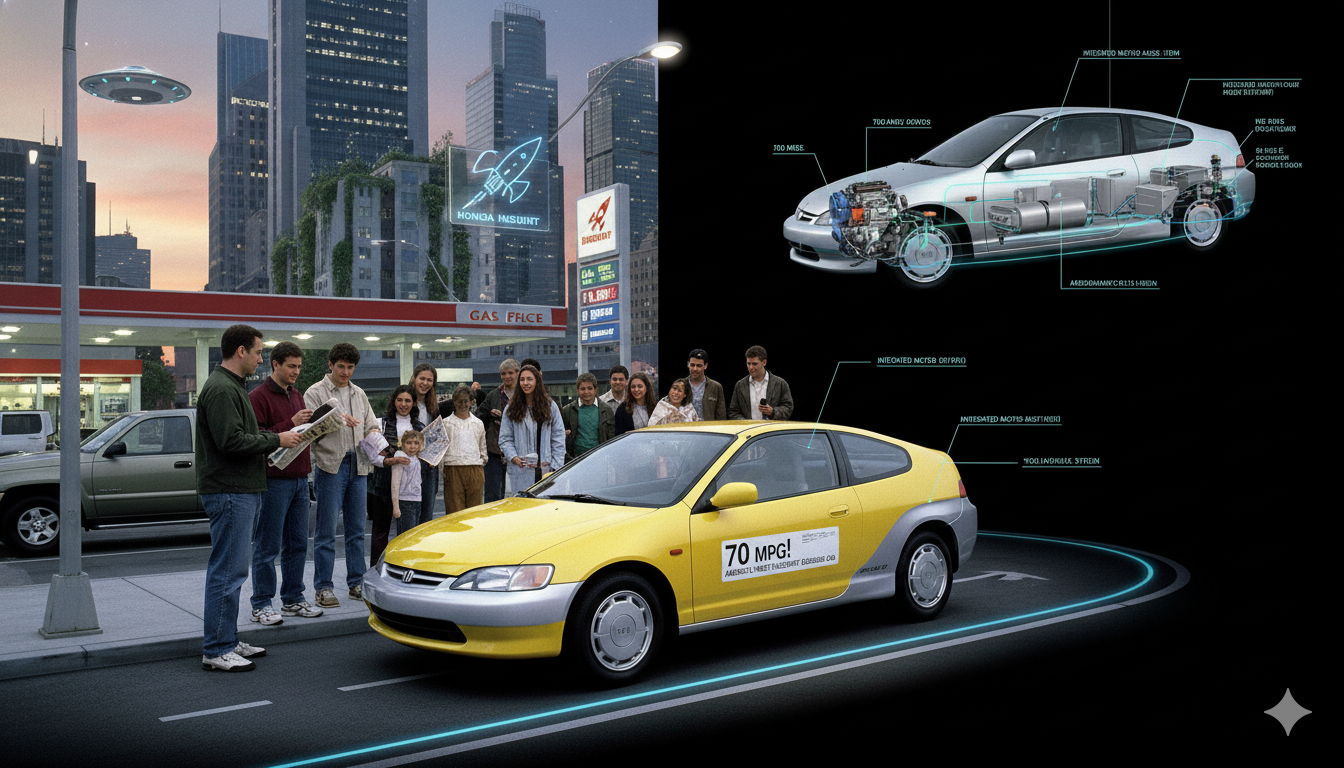
Have you ever seen a car that looks like a little spaceship from the future? That is exactly what people thought when the 2000 Honda Insight first hit the streets. It was a time when big SUVs were everywhere, but Honda decided to do something totally different. They built a car that wasn’t just small; it was the most fuel-efficient gasoline car in America. Even today, over twenty years later, people still talk about this car like it is a piece of magic. It is a two-door hybrid that was designed to save you as much money at the gas pump as possible.
When you sit inside a 2000 Honda Insight, you realize quickly that this isn’t your typical commuter car. It only has two seats! Honda removed the back seats to make room for the large battery pack that helps the engine. This car was all about being light and slippery in the wind. Because it is made mostly of aluminum, it weighs very little compared to a normal car. If you are looking for a vehicle that feels like a science project but drives like a dream, the first-generation Insight is a legendary choice that still holds up.
Key Specifications and Features Table
| Feature | Details |
| Engine Type | 1.0L 3-Cylinder Hybrid (IMA) |
| Horsepower | 67 hp @ 5700 rpm |
| Transmission | 5-Speed Manual or CVT |
| Curb Weight | 1,856 lbs (Super Light!) |
| Fuel Economy (EPA) | 61 City / 70 Highway MPG |
| Seating Capacity | 2 People |
| Body Material | Aluminum Alloy |
| Drive Type | Front-Wheel Drive (FWD) |
Why the First Generation Insight Was a Game Changer
The 2000 Honda Insight was the very first hybrid car sold in the United States. It beat the famous Toyota Prius to the market by several months! Back then, the idea of a car using both a gas engine and an electric motor was brand new. Honda used a system they called “Integrated Motor Assist” or IMA. This system put a thin electric motor between the engine and the transmission. It helped the car accelerate without using extra gas. It was like having a little invisible hand pushing the car forward whenever you stepped on the pedal.
Another reason the 2000 Honda Insight was so special was its “Lean Burn” technology. This allowed the engine to use a very small amount of fuel when you were just cruising down the highway. Because the car was so light and aerodynamic, it didn’t need much power to stay moving. Engineers even gave it rear-wheel skirts (covers over the back tires) to help it slice through the air better. It remains one of the most aerodynamic production cars ever built, which is why the fuel mileage is still hard to beat even by modern electric cars.
Amazing Fuel Economy: Can You Really Get 70 MPG?
The most famous thing about the 2000 Honda Insight is definitely its gas mileage. The EPA rated it at 70 miles per gallon on the highway. Think about that for a second! You could drive from Los Angeles to San Francisco on just a few gallons of gas. In the real world, many drivers report getting even better than that. Some “hypermilers”—people who try to get the best mileage possible—have pushed these cars to over 100 MPG. It is the ultimate car for someone who hates stopping at gas stations.
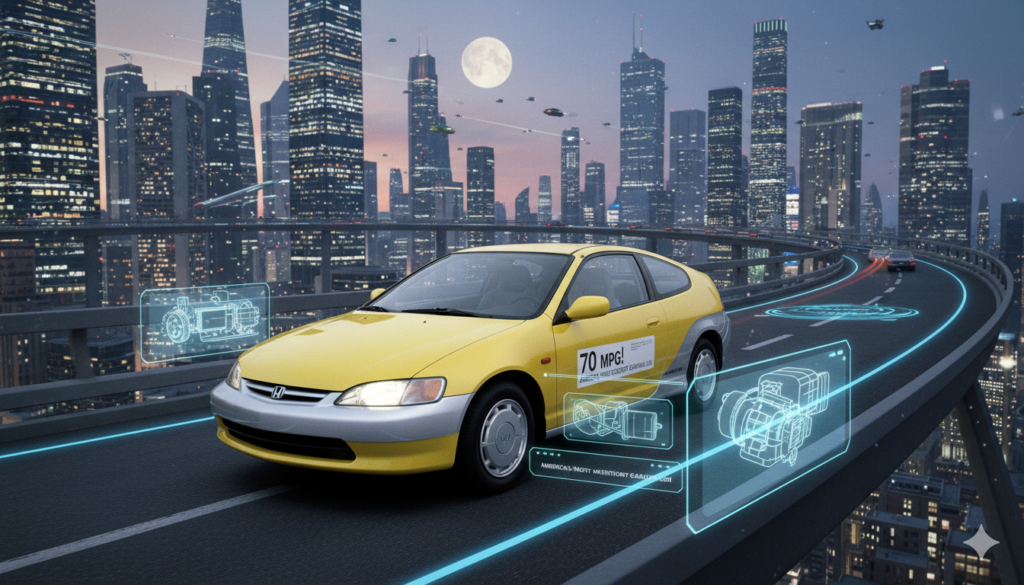
How does the 2000 Honda Insight do it? It’s a mix of a tiny 1.0-liter engine, a very lightweight body, and those skinny tires. The car uses special low-rolling-resistance tires that don’t stick to the road too much. This means the engine doesn’t have to work as hard to keep the wheels turning. If you find a well-maintained model today, you will likely still see 60 to 65 MPG without even trying hard. It makes modern cars that get 30 MPG look like they are wasting a lot of fuel!
Understanding the Integrated Motor Assist (IMA) System
The “brain” of the 2000 Honda Insight is the IMA system. Unlike some hybrids today that can drive on just electricity, the Insight’s engine is almost always running. The electric motor is there to provide a “boost.” When you stop at a red light, the engine actually shuts off to save fuel. This is called “Auto Stop.” As soon as you put the car in gear and let off the brake, the electric motor spins the engine back to life instantly. It feels very smooth once you get used to it.
The battery pack for the 2000 Honda Insight is located behind the seats. It’s a Nickel-Metal Hydride (NiMH) battery. The cool part is that you never have to plug this car in. It charges itself through “regenerative braking.” Whenever you slow down or coast, the electric motor turns into a generator. It takes the energy from the moving wheels and sends it back into the battery. This makes the 2000 Honda Insight very easy to own because it works just like a regular gas car but with much better technology.
Driving Experience: What Is It Like on the Road?
Driving a 2000 Honda Insight is a unique experience. Because it is so light, it feels very “tossable” and nimble in traffic. It isn’t a fast car by any means—it takes a while to get up to highway speeds—but it feels quicker than the numbers suggest because of the electric boost. However, because it is so light and has skinny tires, you might feel the wind pushing you a little bit on a stormy day. It’s a car that rewards a patient driver who enjoys the “game” of saving fuel.
Inside the 2000 Honda Insight, the cockpit feels very driver-focused. The digital dashboard looks like something out of a 1980s sci-fi movie. It has a glow-in-the-dark fuel economy meter that shows you exactly how much gas you are using in real-time. This actually helps you become a better driver! You start to learn exactly how much pressure to put on the gas pedal to stay in the “green zone.” It turns driving into a fun challenge to see how high you can get your MPG numbers.
Aluminum Construction: A Rust-Proof Wonder
Most cars are made of steel, which can rust over time, especially if you live somewhere with snow and salt on the roads. The 2000 Honda Insight is different. Most of its frame and body panels are made of aluminum. This was a very expensive way to build a car back then, but it was necessary to keep the weight down to 1,856 pounds. For comparison, a modern Honda Civic weighs almost 3,000 pounds! The lighter weight is the secret sauce to its incredible efficiency and longevity.
The benefit for buyers today is that a 2000 Honda Insight usually won’t have the same rust issues as other old cars. While the suspension parts can still get rusty, the main body stays clean. This makes it a great candidate for a long-term commuter vehicle. Even if the car has a lot of miles on it, the “bones” of the car are likely still in great shape. Honda really went above and beyond with the build quality, showing their commitment to making a car that would last for decades.
Common Maintenance for an Older Hybrid
If you are thinking about buying a 2000 Honda Insight today, there are a few things to keep in mind. The most important is the IMA battery. These batteries usually last about 8 to 10 years. Since these cars are now much older, many have had their batteries replaced already. If the “IMA” light comes on the dashboard, it usually means the battery is getting weak. Luckily, there are many companies now that sell improved replacement batteries that are better than the originals.
Other than the battery, the 2000 Honda Insight is known for being very reliable. The 3-cylinder engine is simple and easy to work on. You will want to check the “ground straps,” which are wires that connect the engine to the frame. Since the body is aluminum, these wires can sometimes get corroded and cause electrical glitches. Also, make sure the manual transmission shifts smoothly. Some early models had a slight “grind” when shifting into second gear, but this is a well-known issue that most Honda mechanics can fix easily.
Is the 2000 Honda Insight Still Practical Today?
You might wonder if a two-seater car from the year 2000 is still a good choice for today’s world. If you have a long commute and usually drive alone, the answer is a big yes! The 2000 Honda Insight can save you thousands of dollars in fuel costs every year. It fits into the tiniest parking spots and is very easy to drive in the city. However, it isn’t the best car for a big family or for hauling furniture from the store. It is a specialized tool for a specific job: maximum efficiency.
Another thing to consider is safety. The 2000 Honda Insight has front airbags and anti-lock brakes (ABS), but it doesn’t have the fancy cameras or sensors found in new cars. Because it is so small, you have to be extra careful around big semi-trucks on the highway. But for many enthusiasts, the trade-off is worth it. There is a huge community of owners who share tips on how to keep these cars running forever. Owning an Insight feels like being part of a special club of smart savers.
Manual vs. CVT: Which One Should You Choose?
When the 2000 Honda Insight first came out, it only came with a 5-speed manual transmission. Later, they added a CVT (Continuously Variable Transmission) which works like an automatic. If you want the absolute best gas mileage, the manual transmission is the way to go. It allows you to use the “Lean Burn” mode, which the automatic version doesn’t really have. Plus, shifting the gears yourself makes the car feel a bit more sporty and fun to drive.
The CVT version of the 2000 Honda Insight is still very efficient, usually getting around 45 to 50 MPG. It is a great choice if you live in a city with a lot of stop-and-go traffic and don’t want to deal with a clutch pedal. However, the manual models are much more popular with collectors and enthusiasts. Whichever one you choose, you are still getting a car that is better for the environment than almost anything else on the road from that era.
The Cultural Impact of the First-Gen Insight
The 2000 Honda Insight didn’t sell in huge numbers when it was new, but it changed how we think about cars. It proved that a hybrid could be reliable and practical for daily use. It paved the way for the Honda Civic Hybrid, the CR-Z, and the modern Accord Hybrid. Collectors now see the original Insight as a “modern classic.” Prices for clean, low-mileage models are actually starting to go up because people realize how special they are.
It’s also a favorite for people who care about the planet. By using less gas, the 2000 Honda Insight puts out fewer emissions. It was one of the first cars to receive an “Ultra-Low Emission Vehicle” rating. In a way, this car was a pioneer for the electric car revolution we are seeing today. It showed that we didn’t need giant engines to get where we were going. It was a bold statement from Honda that “less is more,” and that message is still very powerful today.
Frequently Asked Questions (FAQs)
1. How long does the battery last in a 2000 Honda Insight? The original IMA batteries usually lasted 80,000 to 100,000 miles. Today, you can buy refurbished or upgraded battery packs that can last even longer. Many owners find that if they drive the car daily, the battery stays healthier.
2. Can I drive the car if the hybrid battery is dead? Yes! One of the best things about the 2000 Honda Insight is that it can still run on just the gasoline engine even if the battery fails. It will be a bit slower and won’t get as good of gas mileage, but it won’t leave you stranded.
3. Is it hard to find parts for such an old hybrid? Common parts like brakes, filters, and spark plugs are easy to find at any auto parts store. Some specific body parts or interior pieces can be harder to find, but there is a very active online community where owners trade and sell parts.
4. How many people can fit in the 2000 Honda Insight? It is strictly a two-seater. There is no back seat at all. Behind the front seats, there is a small storage shelf and then the compartment for the hybrid battery and the spare tire.
5. Does the 2000 Honda Insight have air conditioning? Most models do! While it was an option when new, almost every Insight you find today will have air conditioning. Just keep in mind that running the AC will slightly lower your total fuel economy.
6. Is the 2000 Honda Insight safe for highway driving? Yes, it can easily keep up with highway speeds (70-75 mph). However, because it is very light, it can feel a bit “floaty” when passing large trucks. It has standard safety features like airbags and ABS to help keep you safe.
Conclusion: A Masterpiece of Engineering
In the end, the 2000 Honda Insight is much more than just an old economy car. It is a masterpiece of engineering that challenged the status quo. Whether you are an SEO professional looking for a quirky daily driver or a student trying to save every penny on gas, the Insight offers something no other car can. It combines futuristic looks, rust-proof aluminum construction, and record-breaking efficiency into one tiny package.
If you ever have the chance to drive or own a 2000 Honda Insight, take it! You’ll be driving a piece of history that still feels like it’s from the future. It’s a reminder that when we focus on efficiency and smart design, we can create something truly timeless. Do you think modern cars have lost the “magic” that the original Insight had? Join the conversation and let us know your thoughts on this hybrid legend!