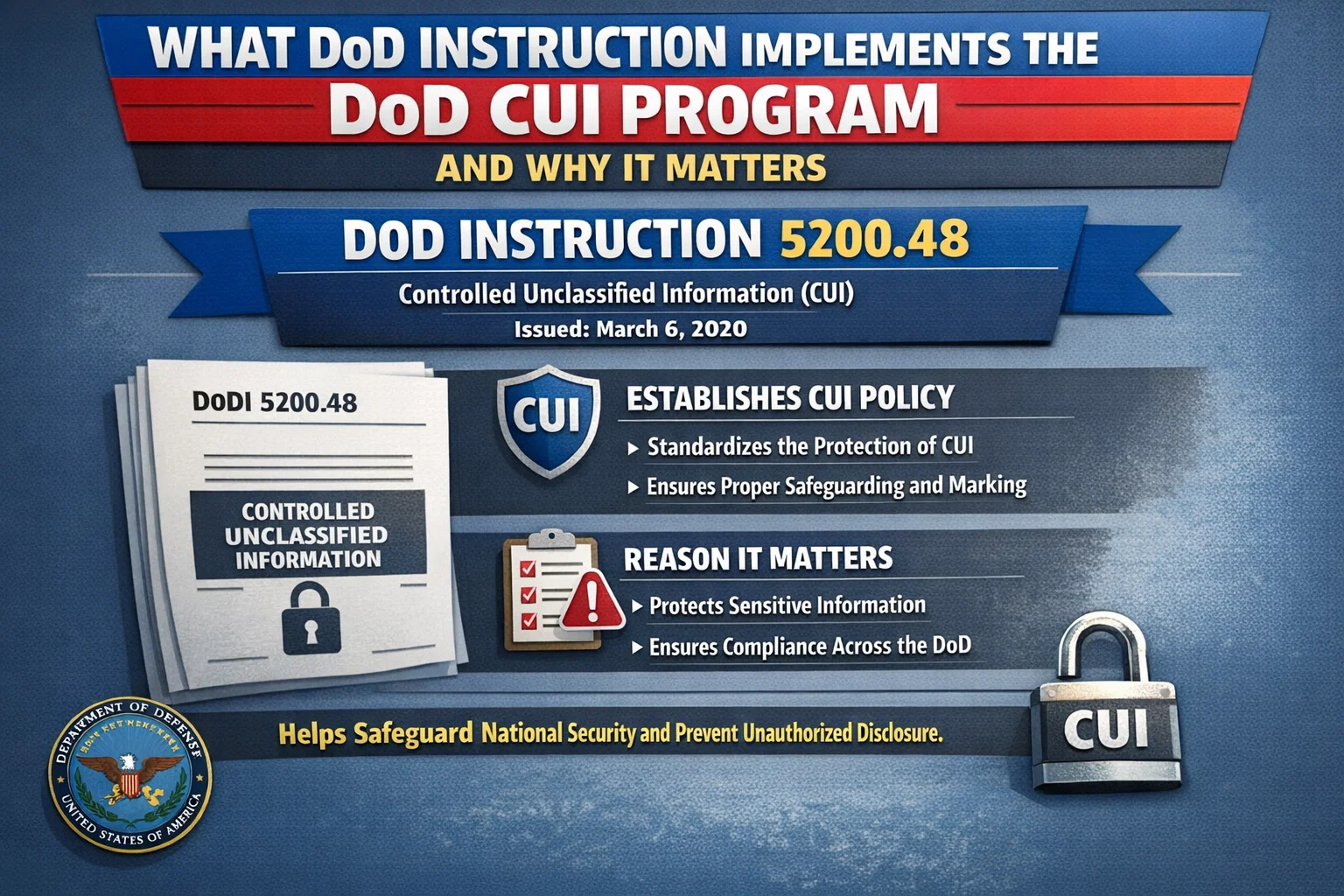
Understanding what dod instruction implements the dod cui program is essential for anyone working with the U.S. Department of Defense, its contractors, subcontractors, and partners. Controlled Unclassified Information, commonly known as CUI, sits in a critical space between public information and classified material. It is not secret or top secret, yet its exposure can still create serious operational, financial, and national security risks.
The DoD did not create the CUI framework casually. It was designed to fix decades of confusion caused by inconsistent labels like “For Official Use Only,” “Sensitive But Unclassified,” and dozens of other unofficial markings. These labels varied across agencies and even within departments, creating uncertainty and weak protection practices. The DoD CUI Program exists to eliminate that inconsistency and enforce a single, authoritative standard.
At the center of that standard is one specific DoD instruction. This article explains the instruction in depth, how it works, who must follow it, how it ties into cybersecurity requirements, and why it has become one of the most important compliance frameworks in the defense ecosystem.
The Official Instruction Behind the DoD CUI Program
The DoD CUI Program is implemented through DoD Instruction 5200.48, formally titled Controlled Unclassified Information (CUI). This instruction is the definitive policy document that establishes how the Department of Defense identifies, marks, safeguards, disseminates, decontrols, and destroys CUI.
When people ask what dod instruction implements the dod cui program, the answer is clear and unambiguous: DoDI 5200.48. This instruction aligns the Department of Defense with the federal-wide CUI framework established under Executive Order 13556. While that executive order applies across the entire federal government, DoDI 5200.48 translates those requirements into concrete, enforceable rules specific to the DoD environment.
The instruction applies to all DoD components, including military departments, combatant commands, defense agencies, and DoD field activities. Importantly, it also extends to contractors and non-DoD entities when they handle DoD CUI through contracts, grants, or agreements.
Why the DoD Needed a Dedicated CUI Instruction
Before the adoption of DoDI 5200.48, the DoD faced widespread inconsistency in how sensitive information was labeled and protected. Different offices used different markings, applied different access controls, and interpreted sensitivity in subjective ways. This inconsistency made compliance audits difficult and weakened information protection across the defense enterprise.
DoDI 5200.48 exists to solve that problem by creating a single rulebook. It defines exactly what qualifies as CUI, how it must be marked, how it should be stored, and how it may be shared. Instead of relying on local customs or legacy practices, personnel and contractors now follow a standardized system rooted in federal law and DoD policy.
As one senior defense official explained during the rollout, “Standardization is not about bureaucracy; it’s about protecting sensitive mission data in a modern, interconnected world.” That philosophy is baked into every section of the instruction.
Relationship Between Executive Order 13556 and DoDI 5200.48
Executive Order 13556, signed in 2010, created the federal CUI framework. It directed all executive branch agencies to replace ad hoc sensitive information markings with a single, controlled system. However, the executive order itself does not provide operational-level guidance for every department.
DoDI 5200.48 serves as the DoD’s implementation of that executive order. It translates high-level federal mandates into defense-specific procedures that account for military operations, defense contracting, joint environments, and classified system boundaries.
Understanding this relationship helps clarify what dod instruction implements the dod cui program within the broader federal context. The executive order sets the foundation, while DoDI 5200.48 builds the structure that DoD personnel actually use every day.
Scope and Applicability Across the Defense Ecosystem
DoDI 5200.48 applies far beyond Pentagon offices. Its reach includes uniformed service members, civilian employees, support contractors, academic research partners, and even foreign partners under specific agreements.
Any organization that creates, receives, stores, processes, or transmits DoD CUI must follow the instruction’s requirements. This includes small subcontractors who may only handle limited technical data as well as large prime contractors managing vast information systems.
The instruction is deliberately broad because modern defense operations rely on distributed information sharing. A single engineering drawing, logistics report, or vulnerability assessment may move through multiple organizations. Without a unified instruction, that information would be protected unevenly at best.
Core Objectives of the DoD CUI Program
The DoD CUI Program is not just about labeling documents. Its objectives are strategic and long-term. First, it ensures that sensitive information receives appropriate protection without unnecessarily restricting access. Over-classification slows operations, while under-protection invites compromise.
Second, the program supports interoperability. When everyone understands the same markings and protection rules, information flows more efficiently between commands and partners. This is especially critical in joint and coalition environments.
Third, the program strengthens accountability. DoDI 5200.48 assigns clear responsibilities to information owners, system administrators, security officers, and leadership. When a failure occurs, there is no ambiguity about which standards were violated.
Categories and Types of Controlled Unclassified Information
CUI is not a single, vague category. DoDI 5200.48 ties DoD CUI to the National Archives and Records Administration CUI Registry, which defines specific categories such as controlled technical information, export-controlled data, privacy information, and critical infrastructure details.
Each category has its own legal basis and handling requirements. For example, controlled technical information may relate to weapons systems, while privacy information involves personally identifiable data. The instruction requires personnel to understand these distinctions and apply markings accordingly.
This structured approach eliminates guesswork and ensures that protection measures match the sensitivity of the information.
Marking Requirements Under DoDI 5200.48
One of the most visible aspects of the instruction is its marking requirements. DoDI 5200.48 mandates standardized banners, portion markings, and dissemination statements for CUI. These markings are not optional or decorative; they communicate legal and policy obligations.
Proper marking ensures that anyone who encounters the information understands its status immediately. It also supports automated systems that enforce access controls and data loss prevention rules.
Improper or missing markings are considered compliance failures, even if the information itself is handled carefully. The instruction makes it clear that markings are a foundational control, not an afterthought.
Safeguarding and Storage Expectations
DoDI 5200.48 establishes baseline safeguarding requirements for CUI, including physical security, access controls, and environmental protections. While it does not replace cybersecurity standards, it integrates closely with them.
Physical documents must be stored in controlled environments, protected from unauthorized access and casual observation. Electronic CUI must be stored on systems that meet approved security standards, particularly when it falls under categories associated with national security or export controls.
The instruction emphasizes proportionality. Safeguards should match risk, ensuring protection without crippling productivity.
Dissemination and Sharing Rules
Sharing CUI is allowed, but it must follow strict rules. DoDI 5200.48 permits dissemination only to authorized recipients with a lawful government purpose. It explicitly prohibits public release unless authorized by the information owner and applicable regulations.
The instruction also addresses sharing with foreign entities, which often requires additional approvals and international agreements. These rules protect sensitive defense information while still enabling collaboration where appropriate.
Understanding these dissemination rules is a key part of understanding what dod instruction implements the dod cui program in practical, day-to-day operations.
Decontrolling and Destruction of CUI
CUI does not last forever. DoDI 5200.48 provides guidance on decontrolling information when legal or policy requirements expire. Once decontrolled, the information may be treated as public or internal data, depending on circumstances.
Destruction requirements are equally specific. Physical CUI must be destroyed using approved methods such as shredding or burning, while electronic CUI must be securely erased to prevent recovery.
These lifecycle controls ensure that protection is applied only as long as necessary, reducing administrative burden while maintaining security.
Roles and Responsibilities Defined by the Instruction
DoDI 5200.48 assigns responsibilities across the organization. Information owners are responsible for identifying and categorizing CUI. Supervisors ensure personnel receive proper training. Security officers monitor compliance and investigate incidents.
Leadership is not exempt. Commanders and directors are accountable for implementing the program within their organizations. This top-down responsibility model reinforces the seriousness of CUI protection.
A frequently cited line from the instruction’s implementation guidance states, “Information protection is a leadership responsibility, not just a technical function.” That mindset shapes how the program is enforced.
Integration With Cybersecurity Standards
While DoDI 5200.48 defines CUI policy, cybersecurity standards define how electronic CUI is protected. The instruction aligns closely with NIST Special Publication 800-171, which outlines security requirements for protecting CUI in non-federal systems.
This alignment is critical for contractors. Compliance with NIST 800-171 is often contractually required, and DoDI 5200.48 provides the policy justification for those requirements.
Together, these frameworks create a layered defense that addresses both policy and technical risk.
Impact on Defense Contractors and Subcontractors
Defense contractors are directly affected by DoDI 5200.48. If a contract involves CUI, the contractor must implement appropriate controls, train employees, and document compliance.
This applies equally to subcontractors, even if they never interact directly with DoD personnel. The instruction’s reach flows down the supply chain, making CUI protection a shared responsibility.
Failure to comply can result in contract termination, financial penalties, and reputational damage. As a result, understanding what dod instruction implements the dod cui program has become a business-critical issue for many organizations.
Training and Awareness Requirements
DoDI 5200.48 requires training for all personnel who handle CUI. Training must cover identification, marking, safeguarding, and incident reporting. It is not a one-time requirement; refresher training is expected as policies evolve.
Effective training reduces accidental disclosures and reinforces a culture of security. The instruction encourages practical, role-based training rather than generic awareness sessions.
Organizations that invest in meaningful training tend to experience fewer compliance issues and incidents.
Incident Reporting and Response
Despite best efforts, incidents happen. DoDI 5200.48 outlines expectations for reporting suspected or confirmed CUI compromises. Timely reporting enables damage assessment and corrective action.
The instruction integrates with existing DoD incident response frameworks, ensuring that CUI incidents are handled consistently and professionally. Transparency and accountability are emphasized over blame.
This approach encourages reporting rather than concealment, which ultimately strengthens security.
Compliance, Oversight, and Auditing
Compliance with DoDI 5200.48 is monitored through inspections, audits, and assessments. These may be conducted internally or by external oversight bodies.
Auditors look for evidence of proper markings, training records, system security controls, and documented procedures. Non-compliance findings can trigger corrective action plans and follow-up reviews.
Regular oversight ensures that the instruction remains a living policy rather than a static document.
Key Differences Between CUI and Classified Information
It is important to distinguish CUI from classified information. Classified data is governed by separate regulations and involves national security classification levels such as Confidential, Secret, and Top Secret.
CUI, while sensitive, does not meet classification criteria. However, mishandling it can still cause harm. DoDI 5200.48 makes this distinction clear to prevent both under-protection and over-classification.
This clarity helps personnel apply the right controls without unnecessary complexity.
Practical Examples of CUI in DoD Operations
CUI appears in many forms. Engineering specifications for military equipment, vulnerability assessments, internal policy drafts, and certain logistics data all commonly qualify as CUI.
In each case, DoDI 5200.48 provides the framework for determining how the information should be marked and protected. These practical applications demonstrate the instruction’s relevance across missions.
Understanding these examples helps contextualize what dod instruction implements the dod cui program beyond abstract policy language.
Table: Core Elements of DoDI 5200.48 and Their Purpose
| Core Element | Purpose |
|---|---|
| Standardized Markings | Ensure consistent identification of CUI |
| Safeguarding Rules | Protect CUI from unauthorized access |
| Dissemination Controls | Limit sharing to authorized recipients |
| Training Requirements | Build awareness and compliance |
| Oversight Mechanisms | Enforce accountability and improvement |
This table highlights how the instruction translates policy into actionable controls.
Challenges in Implementing the Instruction
Implementing DoDI 5200.48 is not without challenges. Organizations often struggle with legacy systems, inconsistent training, and cultural resistance to change.
Some personnel view CUI requirements as administrative burdens rather than security enablers. Overcoming this mindset requires leadership engagement and clear communication about risks.
Despite these challenges, organizations that fully implement the instruction report improved information hygiene and reduced incidents.
Benefits of a Unified CUI Framework
The benefits of DoDI 5200.48 extend beyond compliance. Standardization improves efficiency, reduces confusion, and supports secure collaboration.
A unified framework also enhances trust between the DoD and its partners. When everyone follows the same rules, information sharing becomes smoother and more reliable.
These benefits reinforce why understanding what dod instruction implements the dod cui program is so important across the defense community.
Future Evolution of the DoD CUI Program
Like all policy frameworks, the DoD CUI Program continues to evolve. Updates to DoDI 5200.48 reflect changes in technology, threat landscapes, and federal guidance.
Future revisions are likely to address cloud computing, zero trust architectures, and advanced data protection technologies. Staying current with these updates is part of ongoing compliance.
Organizations that treat the instruction as a living document are better prepared for future changes.
Conclusion
DoDI 5200.48 is the authoritative answer to what dod instruction implements the dod cui program. It establishes a clear, enforceable framework for protecting Controlled Unclassified Information across the Department of Defense and its extended enterprise. By standardizing markings, safeguarding practices, dissemination rules, and accountability, the instruction closes long-standing gaps in information protection.
For DoD personnel, contractors, and partners, understanding and implementing this instruction is not optional. It is a core responsibility tied directly to mission success, national security, and professional credibility. Organizations that embrace the principles of DoDI 5200.48 position themselves for stronger compliance, better collaboration, and a more secure information environment.
FAQ Section
What dod instruction implements the dod cui program for contractors?
The instruction is DoD Instruction 5200.48, which applies to contractors when they handle DoD Controlled Unclassified Information under contracts, grants, or agreements.
Why is DoDI 5200.48 important for cybersecurity compliance?
DoDI 5200.48 establishes the policy foundation for protecting CUI, which aligns with cybersecurity standards such as NIST SP 800-171 for securing electronic information.
Does DoDI 5200.48 replace classified information rules?
No, it does not. The instruction applies only to Controlled Unclassified Information and operates separately from classified information regulations.
Who is responsible for enforcing CUI rules under DoDI 5200.48?
Responsibility is shared among information owners, supervisors, security officers, and leadership, ensuring accountability at every level.
How often is training required under the DoD CUI Program?
Training is required initially and periodically thereafter, ensuring personnel remain aware of current requirements and best practices related to what dod instruction implements the dod cui program.