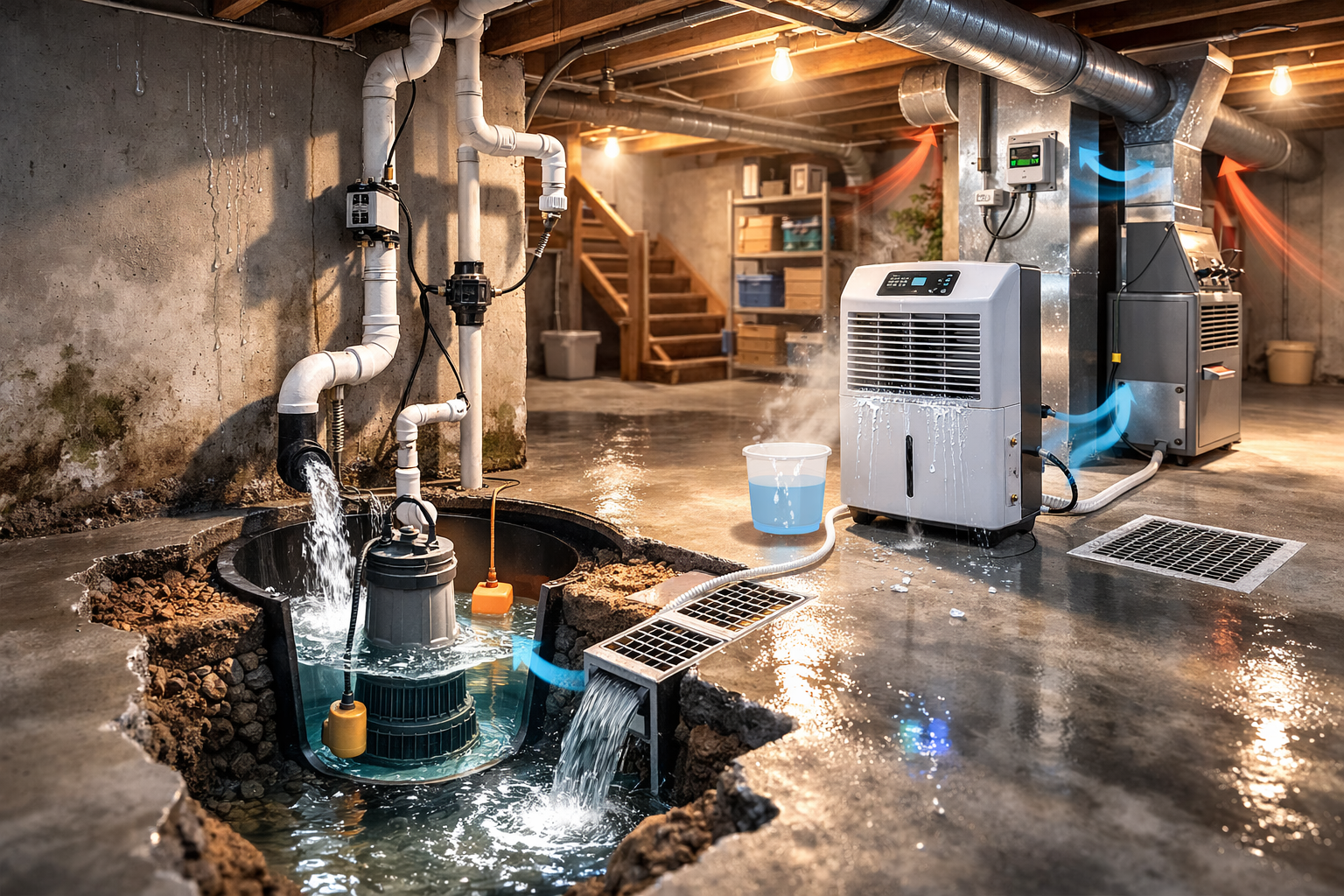
Basement moisture problems rarely have just one cause. Groundwater can rise after storms, humid outdoor air can seep in through rim joists and cracks, and HVAC systems can create pressure changes that pull in damp air. When moisture builds up, the basement can smell musty, feel clammy, and quietly damage insulation, framing, and stored items. Sump pumps and dehumidifiers solve different pieces of the puzzle. A sump pump removes liquid water that collects under the slab or around the foundation, while a dehumidifier removes water vapor from the air. Pairing both with HVAC strategies helps you control moisture at the source and stabilize indoor air, keeping the basement comfortable and healthier year-round. The goal is not simply to dry the basement for a week, but to prevent recurring cycles of dampness that return with each season.
Build a complete moisture plan.
- Separate Liquid Water Problems From Humidity Problems
A sump pump is designed for managing liquid water, not for controlling humidity. If the basement has puddles, water stains near the slab edge, or a sump pit that fills quickly after rain, the priority is managing groundwater and surface drainage. That can include checking gutters, downspouts, grading, and whether the discharge line sends water far enough away from the foundation. A reliable pump setup also includes a properly sized pit, a sealed lid to limit humidity and odors, and a check valve to prevent short cycling. Humidity is different. A basement can be damp even without visible water if warm, humid air condenses on cooler walls and pipes. That is where a dehumidifier becomes essential, because it lowers the moisture level in the air so condensation stops forming. HVAC ties into this because temperature and airflow influence relative humidity. If the basement is colder than the rest of the home, the same amount of moisture in the air produces a higher relative humidity reading, which can feel sticky even when the upstairs is comfortable. Understanding which moisture source is dominant helps you avoid relying on a dehumidifier to compensate for active water intrusion, or on a sump pump when the real issue is vapor and condensation.
- Use HVAC Airflow Without Creating New Moisture Paths
Many basements are connected to the home HVAC system through supply ducts, returns, or air leakage. This can help or hurt depending on how it is set up. Supplying conditioned air can stabilize temperature and reduce humidity swings, but it must be balanced so you do not create negative pressure that pulls in damp outdoor air through cracks. Basements can also attract odors and humidity if the space is not properly sealed and controlled. A smarter approach is to focus on air sealing first, especially at rim joists, utility penetrations, and gaps around ducts and pipes. After sealing, ventilation and HVAC distribution can be adjusted to provide gentle circulation without turning the basement into a pressure sink. If the home has a furnace or air handler located in the basement, duct leakage can blow humid air into wall cavities or pull musty air into the system. Addressing that leakage also improves comfort upstairs. Sometimes moisture complaints arise when heating performance drops, and homeowners seeking furnace repair in Florence handled by Price Heating & Air Conditioning may also discover that duct sealing and moisture control need to be addressed alongside the equipment service to prevent the basement from feeling damp again.
- Choosing and Placing Dehumidifiers for Real Results
A dehumidifier works only as well as its sizing, placement, and drainage plan. Many basements need a unit that can run continuously during humid months, not a small portable model meant for occasional use. Placement matters because dead corners and enclosed storage areas can stay damp even if the rest of the basement is dry. Placing the unit near a main moisture source, such as a cool, damp foundation wall, can improve performance, but airflow must be unobstructed. Drainage is another key. If the dehumidifier fills a bucket that overflows or shuts off, humidity returns fast. Continuous drainage to a sump pit, floor drain, or condensate pump helps maintain consistent operation. Also, think about how the dehumidifier interacts with HVAC. If the basement receives conditioned air, the dehumidifier may run less. Still, if the basement is isolated and cool, it may run more because cool air holds less moisture before reaching high relative humidity. Aim for a stable humidity target that prevents condensation, typically in the midrange rather than in extremely dry settings, which wastes energy and increases wear. A humidity monitor in multiple locations helps confirm whether the space is actually stable.
Combine Removal and Air Control
Basement moisture control works best when sump pumps and dehumidifiers are treated as complementary tools and coordinated with HVAC airflow. The sump pump manages liquid water and reduces flood risk, while the dehumidifier manages water vapor that causes musty odors and condensation. HVAC can support the plan by stabilizing temperature and circulation, but only after air sealing prevents the basement from pulling in damp outdoor air. Proper sizing, placement, and continuous drainage make dehumidifiers more consistent, while backup power, correct discharge routing, and sealed lids make sump pumps more dependable. When these pieces work together, the basement stays drier across seasons, indoor air feels more comfortable, and moisture-driven damage becomes far less likely to return.